How I Get Multiple Citations of My Papers in a Single Article (Without Bribing Anyone)
Every now and then, someone will ask me (sometimes jokingly, sometimes with a hint of suspicion) how I manage to get several of my papers cited in one article by another researcher.
Well, first of all, let me assure you: I don't have a secret underground lab where I hypnotize authors into citing me (though if you know how to build one, let's talk).
But seriously, there is a bit of a method to the madness, and since someone recently asked me this exact question, I thought I'd break it down.
1. I Organize My Work Into Research Collections
One-off papers are fine, but I prefer to work in clusters, not islands. When I explore a research problem, I usually end up writing multiple papers that look at different angles of it: theory, experiments, applications, implications, and the occasional detour into "why does this even work?" territory.
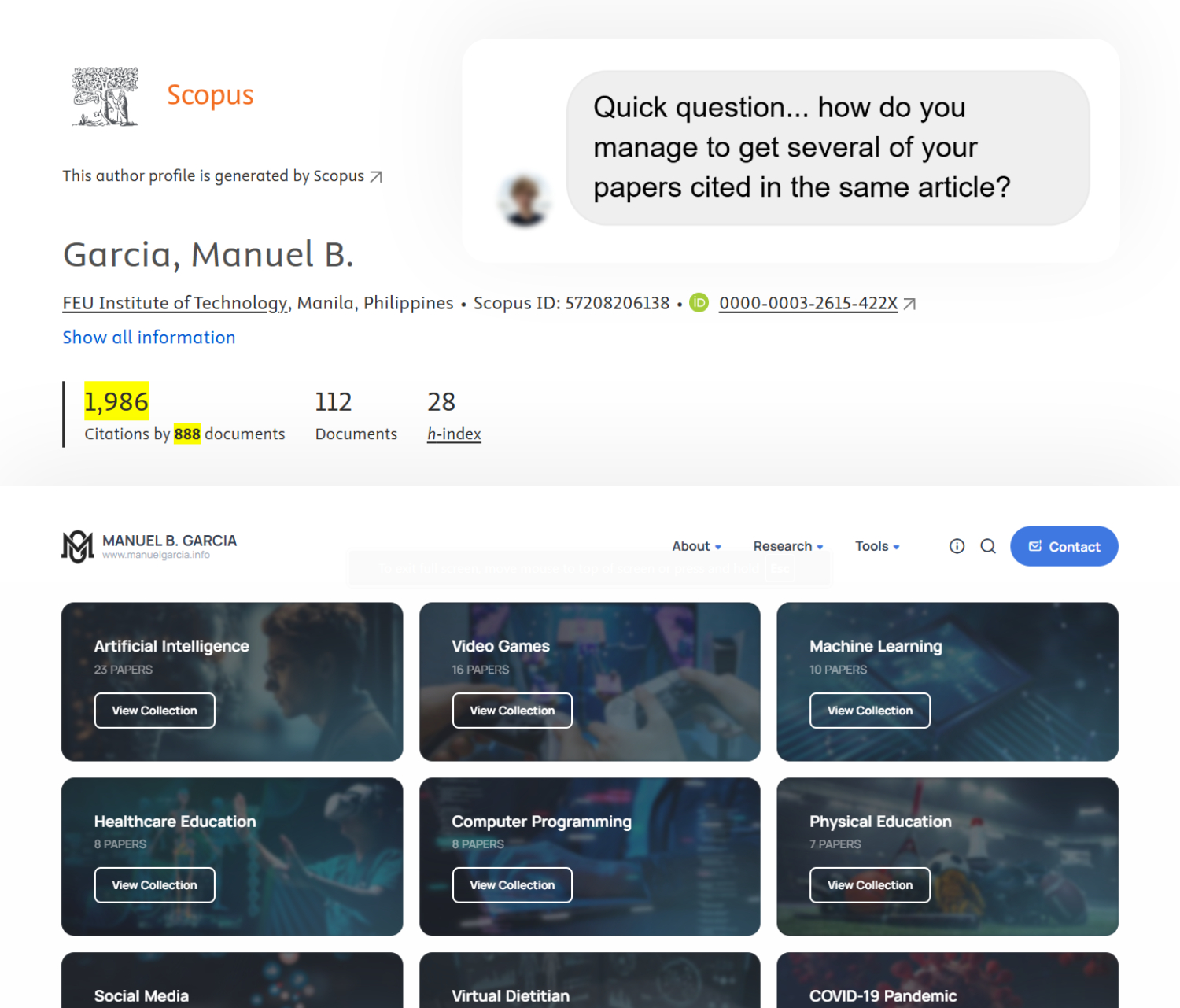
Over time, these become what I like to call Research Collections, or groups of papers that form a coherent thread or tackle a theme in depth. These collections make it easier for other researchers to follow the storyline, see the bigger picture, and cite multiple pieces in one go, because the papers complement each other.
Think of it like planting a garden: if you scatter seeds all over the place, you might get a few lonely flowers. But if you plant in one spot and take care of it, you get a lush, noticeable patch. Researchers wandering by can't help but stop and take a few references with them.
In fact, I've just launched a new section on my website called Research Collections (creative name, I know) where I've grouped together sets of my papers around specific topics. Think of it as the Netflix playlist for my academic work. You can browse them, jump into a series, or binge-read if you're feeling brave.
Shameless plug!
2. I Make My Work Citable (i.e., Useful)
Let's face it. Nobody wants to cite fluff. So I aim to write papers that solve specific problems or offer tools others can actually use. If a paper only offers "thoughts and vibes," it might get one sympathy citation (if I'm lucky). But if it offers a framework, a method, or a dataset that others genuinely need? That's where the real citation magic happens.
I'm always asking: What does this paper give to the reader that they can walk away with and reuse? The more practical or transferable the contribution, the more likely it'll get cited—not just once, but across multiple contexts. People cite what they can use.
3. I Stay Visible, and I Collaborate with the Right People
Look, I'm not a fan of shouting into the void. I share my work, I discuss it, I ask questions, I review others' work, and I try to be a helpful presence in my field. If someone's working on a problem I've tackled, chances are we've at least crossed paths on a mailing list, conference Q&A, or peer review.
And here's another key piece: I collaborate with people who are genuinely interested in the same questions I'm asking. We don't just overlap on keywords... we're chasing the same puzzle from different angles. That naturally leads to multiple relevant citations across our joint and individual work.
Visibility isn't about self-promotion. It's about being part of the conversation and part of the community.
4. Sometimes, I Just Get Lucky
Honestly, not everything is strategy. Sometimes a researcher is working on a topic I happen to have written extensively about, and boom... they find themselves citing 2–3 of my papers. There's no way to manufacture that, and I don't pretend to.
But that's kind of the point: the deeper and more sustained your engagement with a topic, the more you increase the odds that your work will keep turning up in other people's bibliographies—without you lifting a finger. Luck favors the well-prepared.
A Few More Tricks I Probably Shouldn't Be Sharing
Since you've made it this far, here are a few bonus strategies I use. Consider them mildly sneaky, but still academically respectable.
5. I Cross-Reference My Own Work Thoughtfully
When I publish something new, I connect the dots. Not just in a "see also" kind of way, but in a way that actually helps the reader follow the development of an idea.
It's not just, "As shown in [3], [7], [9]..."
It's more like: "We previously introduced X for solving Y. Here, we adapt that approach to tackle Z."
This signals to future writers that your work builds on itself. It gives them a natural roadmap for citing multiple pieces of your work together because you've already shown them how the pieces fit.
6. I Write With Citation Paths in Mind
While I'm outlining a paper, I ask myself: "If someone wants to cite this, what's the quote-worthy bit?" It could be a crisp result, a reusable method, a catchy term—anything that's easy to point to and hard to paraphrase away.
To make that easy, I break down big ideas into digestible, modular chunks: a table of findings, a conceptual diagram, a two-line summary of a result.
Sometimes, I even sneak in a line that practically writes itself into someone's lit review. I've had colleagues quote me word-for-word—and I don't blame them. I made it too easy.
7. I Collaborate Strategically (But Not Cynically)
Collaboration expands your citation network in the most natural way possible. When I work with co-authors on a new angle or applied version of something I've done before, it's only logical that we refer back to earlier papers.
This isn't about padding citation counts. It's about building a connected research program across people, topics, and time. But yes, it does happen to help with those lovely multi-paper citations too.
8. I Write With Future Papers in Mind (Including My Own)
Every time I finish a paper, I drop a few breadcrumbs for the next one. Not in an artificial way, but in the form of open questions, possible extensions, or semi-bold claims like: "While this paper focuses on A, future work could explore how these ideas generalize to B and C."
I'm not just hinting at follow-ups... I'm carving out the path. And let's be real: sometimes, Future Me is the one who picks it up. When that happens, boom... built-in citations from old me to new me.
It's like leaving academic Easter eggs. Someone's bound to pick one up, and when they do, your earlier work comes along for the ride.
One Last Thing: Citations Aren't Everything
Let me say it out loud: it's not just about citation counts.
Sure, getting cited feels good. It's a sign your work is being seen, recognized, maybe even built upon. But ultimately, the goal isn't to rack up numbers on Google Scholar. The goal is to make a contribution that shapes the way people think, solve, experiment, or question within your field.
The most meaningful outcomes of my work haven't come from seeing my name in someone else's references list. They've come from hearing, "Hey, we used your paper and it helped us crack a problem we were stuck on," or "Your article gave us the vocabulary we didn't know we needed."
That’s the real win. When your research becomes useful. When it becomes part of someone else's thinking toolkit. When it’s not just cited, it's used, taught, applied, and maybe even challenged (because that's when it really starts to grow).
So yes, I have a few tricks for earning citations. But I'd trade them all for the moments when I know my work actually moved someone's research forward.
Over to You
How do you organize your work for long-term impact? Do you have your own tricks for getting multiple citations in a single paper or spotting others who do?
I'd love to hear your thoughts. Drop me a message, leave a comment, or just send over your best research collection meme. (Bonus points if it includes a flowchart and a cat.)
Want to browse my Research Collections? Go ahead and check out this new section of my site. I promise it's better organized than my kitchen.