What on Earth is FWCI, and Why Researchers Should Care About This Scopus Metric
Learn what Field-Weighted Citation Impact means, why it matters in research impact, and how my FWCI of 12.39 shows influence beyond citations and h-index.
Whenever I get invited to give a talk about research, I can't help but sneak in a little "metrics corner." It's the part where I show the audience how we measure research productivity and impact beyond just counting papers or flexing an h-index. I always say: "Citations are nice, h-index looks cool on your CV, but if you want a fair metric… let's talk about FWCI."
First Things First: What FWCI Really Is
FWCI stands for Field-Weighted Citation Impact. It indicates how the number of citations received by a publication (or a set of publications) compares with the average number of citations received by similar publications in the Scopus database. "Similar" means the same field (based on journal classification), publication year, and document type.
- Field → so physics isn't unfairly compared to nursing or literature.
- Year → so your 2024 paper isn't punished against a 2010 classic.
- Document type → so a short editorial isn't unfairly stacked against a review article.
If academic publishing were a track meet, some disciplines run on sprint tracks (citations arrive fast), while others are marathons (citations accumulate slowly). Comparing raw citations across fields is like making sprinters and marathoners run the same race. FWCI fixes that by ensuring we only compare like with like.
Think of it like grading exams: scoring 80% in a very tough exam might put you in the top 5%, while scoring 95% in an easier test might only be average. FWCI adjusts for the "difficulty level" of your field, year, and document type so your research is judged fairly against its true peers.
FWCI can be applied at different levels of analysis, which makes it useful not just for individuals but also for larger comparisons:
- Paper level → how a single article performs against its peers.
- Researcher level → your body of work, which is what my figures above represent.
- Department or institution level → benchmarking programs and universities.
- Country or region level → often used in national and global research analyses.
For this post, I'm focusing on my researcher-level FWCI, since it highlights how my personal publications compare with global averages in my field.
How FWCI Is Calculated
Think of it as a ratio of what you actually got versus what would be expected for comparable publications:
- Expected citations per paper → the baseline for similar papers in the same field, year, and type.
- Your actual citations → how many citations your paper actually received.
- Paper FWCI = Actual ÷ Expected. For a set of papers, FWCI is the sum of Actual citations divided by the sum of Expected citations.
Worked example (illustrative only):
- Paper A: Expected = 4, Actual = 60 → 15.0
- Paper B: Expected = 6, Actual = 75 → 12.5
- Paper C: Expected = 3, Actual = 30 → 10.0
- Paper D: Expected = 2, Actual = 21 → 10.5
Total expected = 15; Total actual = 186 → FWCI = 186 ÷ 15 = 12.4.
Now, here’s the important part: while the numbers above are just for demonstration, my real FWCI is 12.39. That means my research is cited about 1,139% higher than the global average for similar publications.

To put this into context, here’s how FWCI thresholds are usually interpreted:
- FWCI = 1.00 → exactly the world average
- FWCI > 1.00 → above the world average (for example, 2.11 means 111% more than average)
- FWCI < 1.00 → below the world average (for example, 0.87 means 13% less than average)
A Quick Disclaimer About Very High FWCI Values
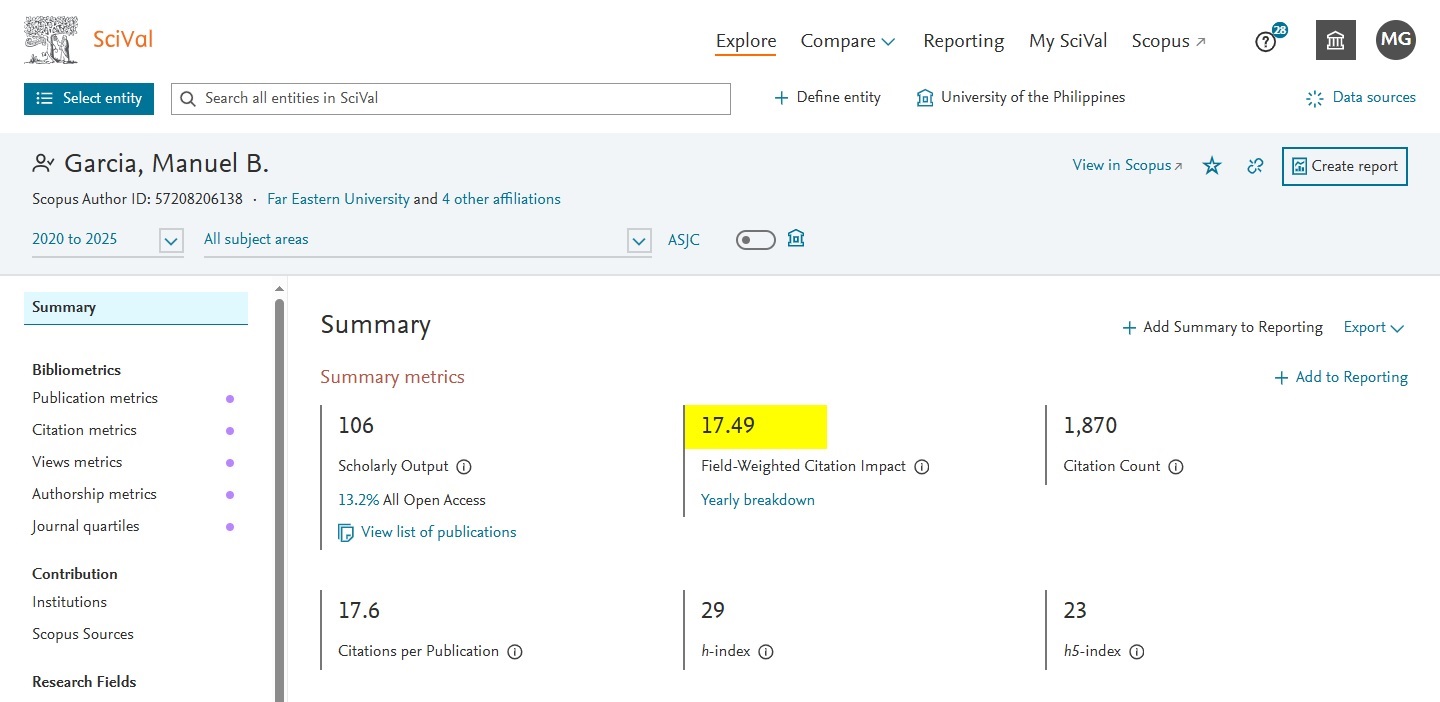
You might notice that my overall FWCI is 12.39, but if I focus only on 2020–2025, it jumps to 17.49. In 2024 it was 29.15, and in 2025 (still in progress) it's currently showing 37.05.
Here are common, perfectly ordinary reasons these values can look very high, especially over short windows of time:
- Small sets magnify ratios. When there are only a few publications in a period, one highly cited paper can move the FWCI substantially.
- Early attention matters. FWCI considers citations in the publication year and the following three years. Rapid uptake on timely topics can elevate the metric quickly.
- Field expectations differ. If a field's expected citations are modest, a well-cited paper stands out more against that baseline.
- In-progress years are provisional. For an incomplete year, totals are still evolving. As more items and citations accrue, the FWCI typically stabilizes.
Because of these dynamics, I interpret FWCI in context and alongside other indicators (citations, h-index, journal venue, altmetrics) and, most importantly, the substance and real-world influence of the research.
Why Researchers Should Care
Metrics in research aren't just about bragging rights but tools that help us understand how our work resonates in the wider scholarly world. FWCI, in particular, has a few qualities that make it worth paying attention to:
- It levels the playing field across disciplines. A medical paper may receive hundreds of citations within months, while an education paper might trickle in citations over years. Raw counts make these two look worlds apart, but FWCI adjusts for disciplinary norms so that both can be compared fairly. In other words, it lets a historian sit at the same table as a computer scientist without either one being penalized by the pace of their field.
- It accounts for time and document type. A 2024 paper shouldn't be punished for not having the same citation history as a 2010 classic. Likewise, an editorial or a short communication shouldn't be stacked against a review article that is naturally citation-rich. FWCI makes these distinctions, giving us a more honest snapshot of influence.
- It emphasizes quality over quantity. You don't need hundreds of papers to demonstrate impact. A few strategically placed, highly cited works can raise your FWCI considerably. This is encouraging for early-career researchers or those in smaller fields, because it highlights that depth can matter just as much as breadth.
- It speaks the language of strategy. Universities, funding agencies, and ranking bodies are increasingly looking at FWCI. Having a strong FWCI signals that your work is not just visible, but globally relevant. For institutions, it helps guide decisions on where to invest, who to support, and how to benchmark against peers. For individual researchers, it can inform publication strategy and collaboration choices.
- It fosters reflection on influence. FWCI forces us to ask: are we publishing just for the sake of publishing, or are we reaching the right audiences who can build on our work? It pushes the conversation away from sheer productivity and toward meaningful contribution.
- It's future-facing. In a world where academic evaluation is evolving, FWCI is part of a broader push for fairer, more nuanced measures of scholarly influence. By paying attention to it now, researchers position themselves ahead of the curve in how impact will be recognized tomorrow.
In short, FWCI isn't just another number to add to your CV. It's a lens that helps you, your institution, and the research community see influence more clearly, fairly, and strategically. That's why, in my talks, I always say: if you want to look at research impact from the “big picture” perspective, FWCI deserves a front-row seat.
Some Tips to Improve FWCI
Since FWCI compares your citations to a global baseline, increasing it is really about increasing both the visibility and relevance of your work. Here are some practical strategies:
- Publish in visible journals. Articles in journals indexed in Scopus with strong readership are more likely to be cited.
- Choose timely and relevant topics. Addressing emerging issues or hot research areas can attract attention faster.
- Collaborate internationally. Papers co-authored across countries and institutions tend to be more widely cited.
- Promote your work. Share your publications on academic platforms (ResearchGate, Google Scholar) and social media to reach broader audiences.
- Open access when possible. Articles available freely online generally achieve higher citation rates.
- Write review articles. Reviews tend to accumulate more citations compared to short communications or editorials.
- Be consistent with keywords. Ensure your abstracts and titles are discoverable in searches by using clear, field-specific terms.
None of these are shortcuts. They're about making research more accessible, relevant, and collaborative. FWCI then reflects that broader influence.
FAQ
Is FWCI the same as h-index?
No. The h-index mixes productivity and citations but does not normalize across fields or years. FWCI asks: "How do my citations compare with the world average for similar publications?"
What is a good FWCI?
1.0 is exactly average; 2–3 is strong; 5+ is excellent; 10+ is exceptional. Always interpret in context (field size, career stage, topic timeliness).
Can a single paper affect FWCI a lot?
Yes, especially when the number of papers in the set is small. One very highly cited item can move the ratio substantially.
Where do I find FWCI?
In Scopus and SciVal, often with trends shown by year of publication.
Should I only use FWCI?
No. Use FWCI alongside other indicators (e.g., citations, h-index, venue quality, collaboration patterns, and qualitative evidence of influence) to get a full, fair view.
Final Thought
FWCI doesn't tell the whole story, but it's one of the best companions for navigating research influence. That's why I highlight it in my talks and why I always consider it together with other metrics to see the full picture of impact.
So next time someone asks about your h-index, smile and say: "That's cute. But have you met my FWCI?"