Apparently, This Is a Series Now: World's Top 2% Scientists 2026
Four consecutive years on the World's Top 2% Scientists list. From 24th to 3rd nationally, with another year of single-year and career-long recognition.
Well, this is getting interesting.
When I first made the World's Top 2% Scientists list in 2023, I wrote about it because it was an unexpected academic milestone. In 2024, I made the list again, which prompted a second article appropriately titled Once Wasn't Enough. Then came 2025, when a third consecutive appearance and my first inclusion in the career-long category convinced me that Third Time's a Pattern was a reasonable title.
And now, in 2026, I have made the list for the fourth consecutive year, once again appearing in both the single-year and career-long scientific impact categories.
Apparently, this is a series now.
I am not entirely sure when an academic achievement becomes an annual blogging obligation, but here we are. At least this particular deadline does not come with Reviewer 2.
Four Years Later, Still on the List
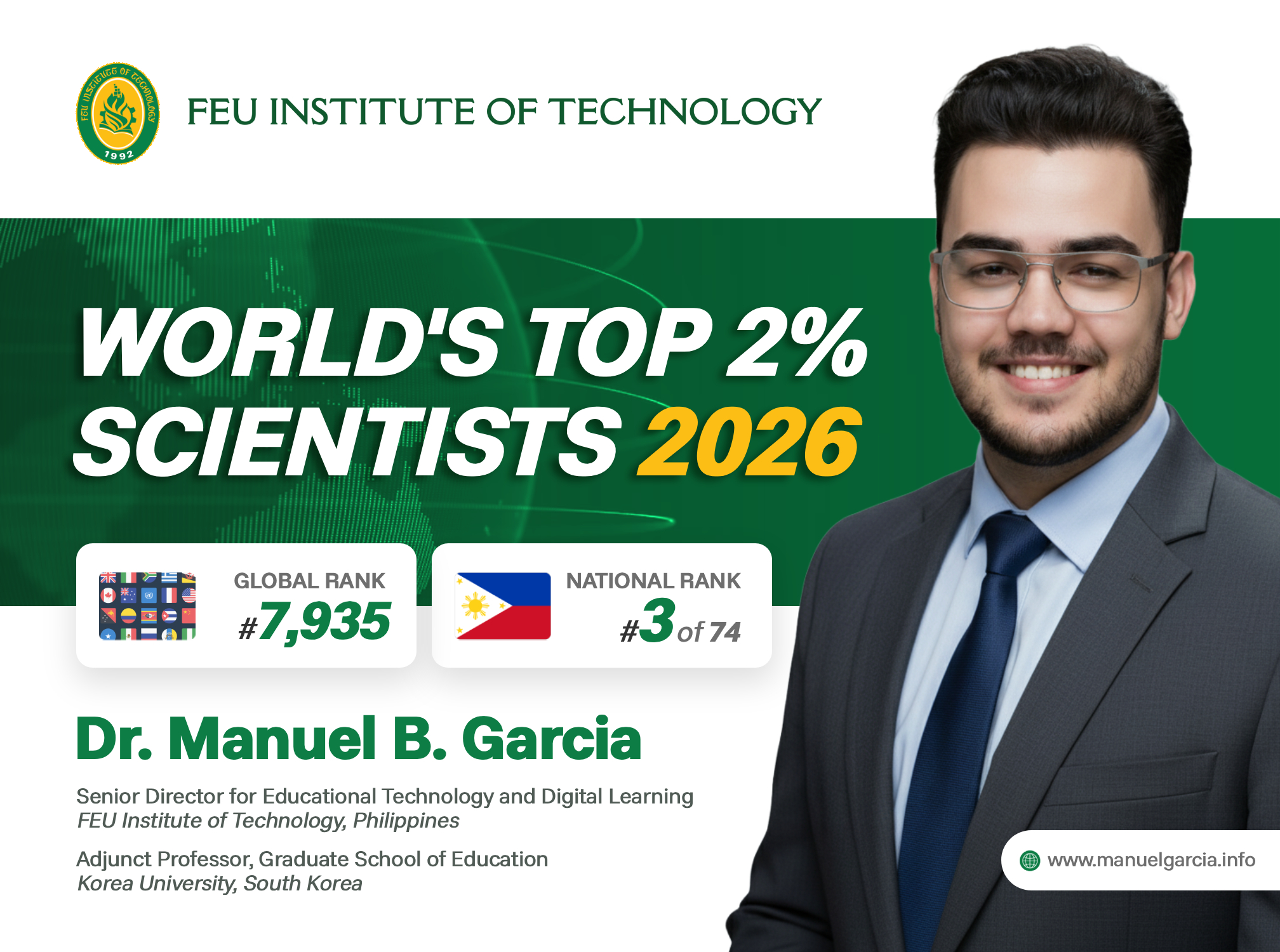
This year's recognition brought another encouraging development. In the single-year category, I ranked 3rd among 74 researchers in the Philippine comparison group and 7,935th globally, with a composite citation score (c-score) of 3.34.
My career-long ranking also changed, moving from 36th nationally and 188,967th globally in 2025 to 29th among 51 nationally and 121,073rd globally in 2026. The corresponding career-long c-score increased from 3.07 to 3.27.
Of course, these are citation-based rankings, not annual performance evaluations. Still, after four consecutive appearances, I thought the numbers deserved another entry in what has apparently become my longest-running academic sequel.
The Journey So Far
Since I started documenting this recognition in 2023, I have kept a record of how my rankings have changed. What began as a simple comparison between two years has now grown into a four-year table.
I suppose this is what happens when a researcher discovers that even personal milestones can become longitudinal data.
Single-Year Scientific Impact
| Single-Year Impact | 2023 | 2024 | 2025 | 2026 |
|---|---|---|---|---|
| National Rank | 24th of 50 | 6th of 58 | 4th of 69 | 3rd of 74 |
| Global Rank | 80,842 | 19,441 | 10,831 | 7,935 |
| C-Score | 2.61 | 3.06 | 3.26 | 3.34 |
Click the year headings to explore my researcher profile and citation indicators for the corresponding edition. National ranks refer to the indicated Philippine comparison groups.
Looking at these figures, the progression is quite striking. My single-year national position moved from 24th in 2023 to 3rd in 2026, while my global position changed from 80,842nd to 7,935th. The c-score also increased from 2.61 to 3.34.
Now, before anyone interprets this as evidence that my research has somehow become ten times better, I should clarify that rankings do not work that way.
Each annual edition reflects a different snapshot of Scopus citation data. Researchers accumulate citations at different rates, author profiles may change, and the relative positions of other researchers also affect the rankings. A change in position is therefore not a direct measure of how much someone's research quality has improved.
Nevertheless, seeing the progression across four editions is encouraging. It suggests that my published work continues to receive scholarly attention, which is something I appreciate regardless of where the numbers eventually settle.
Career-Long Scientific Impact
My inclusion in the career-long category began in 2025, making this the second year in which I have appeared in both datasets.
| Career-Long Impact | 2023 | 2024 | 2025 | 2026 |
|---|---|---|---|---|
| National Rank | Not listed | Not listed | 36th of 44 | 29th of 51 |
| Global Rank | Not listed | Not listed | 188,967 | 121,073 |
| C-Score | Not listed | Not listed | 3.07 | 3.27 |
My first career-long inclusion was in 2025. The earlier years are marked "Not listed" because I was not included in those editions' career-long datasets.
What interests me about these figures is that the single-year and career-long rankings offer different perspectives on citation impact.
The single-year category examines citations received during a particular calendar year, while the career-long category considers citation indicators accumulated over a researcher's publication history. The latter is particularly interesting because research does not always attract attention immediately after publication.
Some studies are cited relatively quickly. Others take years before researchers begin building upon them. And some papers seem to develop a scholarly life of their own long after their authors have moved on to entirely different research questions.
That is one reason I appreciate appearing in the career-long category. It offers a longer perspective on the attention my research has received, even though I recognize that citations alone cannot fully represent its contribution.
When Rankings Become a Research Question
One interesting consequence of appearing on this list repeatedly is that I have become increasingly curious about the data behind it.
As researchers, we often encounter rankings presented as finished products. We see a name, a number, and perhaps a congratulatory announcement. What we do not always see is how those numbers were calculated, which indicators were used, or how researchers compare across different editions.
And I think those questions are worth asking.
For instance, why might a researcher rank highly in the single-year category but occupy a different position in the career-long category? How much do the rankings change from one edition to another? What happens when we examine citation indicators rather than focusing exclusively on the final position?
These questions become especially relevant when rankings are interpreted as measures of scientific excellence rather than what they actually represent: standardized indicators of citation impact.
That distinction matters to me, particularly as someone whose work involves research and evaluation. Numbers can be informative, but their meaning depends on how they were produced and how carefully we interpret them.
Perhaps the researcher in me simply cannot resist examining the measurement behind the recognition. Even when I am one of the people being measured.
Four Years, and Still Learning
Looking back at my first inclusion in 2023, I did not imagine that I would eventually be writing four articles about the same recognition.
Yet each year has brought something slightly different. The first was an unexpected milestone. The second showed a considerable change in my citation-based ranking. The third introduced my first career-long recognition. And the fourth has given me an opportunity to reflect on how those indicators have developed across several editions.
What has remained consistent is my appreciation for the people behind the research.
Every publication represents more than an entry in a database. There are collaborators who contributed ideas, colleagues who challenged assumptions, and reviewers whose comments sometimes required more revisions than I initially thought possible. There are also researchers who subsequently read, questioned, or cited the published work.
That broader scholarly conversation is ultimately what makes research worthwhile to me.
I am grateful for this fourth consecutive inclusion, and particularly pleased to appear once again in both the single-year and career-long categories. At the same time, I know that no ranking can capture everything that matters about a researcher's work.
Some contributions are visible through citations. Others are reflected in the students we teach, the practices we improve, or the questions we encourage others to investigate. Not everything worth contributing to academia comes with a numerical rank.
As for whether there will be a fifth installment, I suppose we will have to wait for the next edition.
Although, at this point, I should probably prepare the spreadsheet in advance.
Four years on the list, and the lesson remains the same: rankings may tell us where our research stands, but they cannot tell us everything our research stands for.
About the Ranking and the Data
The 2026 World's Top 2% Scientists database is based on the August 2026 update of the science-wide author databases of standardized citation indicators, published by Elsevier on October 7, 2026. This edition uses a Scopus snapshot from August 1, 2026, with citation indicators updated through the end of 2025.
Explore the World's Top 2% Scientists Database
Curious about the rankings? I developed an independent World's Top 2% Scientists website where you can explore researcher profiles without navigating the original spreadsheets.
Explore the DatabaseThis is an independent data exploration resource and is not an official ranking platform operated or endorsed by Stanford University or Elsevier.