Before a Paper Can Be Cited, It Has to Be Found: The Overlooked Role of SEO in Academic Publishing
In my previous reflection, I wrote about timing: Timeless Questions, Timely Moments.
I compared two of my papers published three years apart and reflected on why the newer one eventually surpassed the older one in citations. The lesson was not that one paper was necessarily better. It was that research enters the world at a particular moment, and sometimes that moment matters.
A timely question enters a conversation when people are already looking for answers.
But that left me thinking about something else.
What happens after people start looking?
They have to find you.
And that brings me to something we do not talk about very often in academic publishing:
SEO.
Yes, search engine optimization.
And strangely enough, this takes me back to a life before journal articles, peer review, and Reviewer 2.
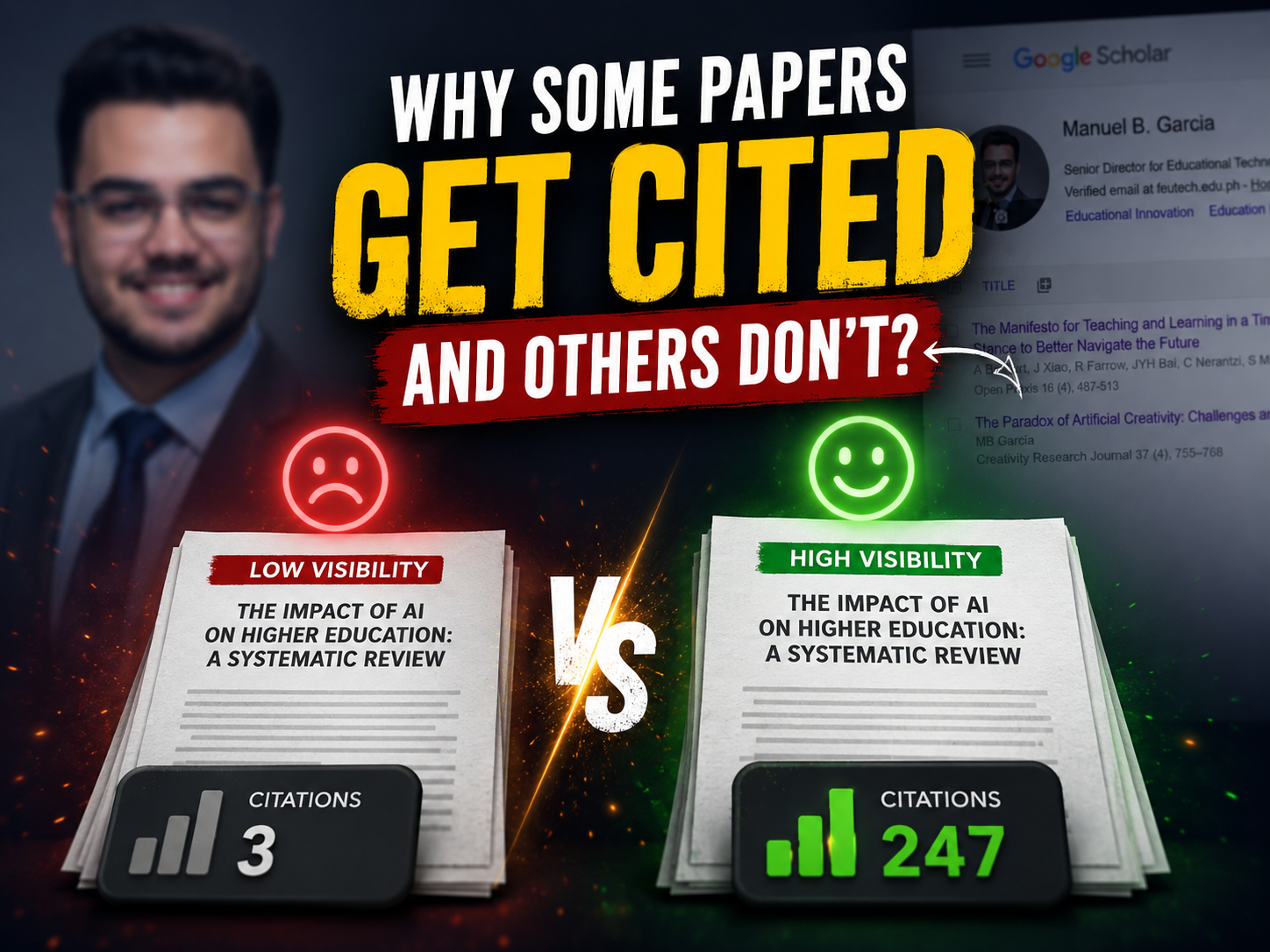
Before I Was Publishing Papers, I Was Publishing Blog Posts
During my college days, I was a blogger.
SEO is therefore not entirely unfamiliar territory to me. Back then, I learned a simple lesson: writing something good was only half the problem.
You could spend hours writing a post, carefully choose your title, press publish, and then discover that Google had apparently decided your masterpiece did not exist.
Titles mattered. Keywords mattered. Links mattered. The website itself mattered. Where and how something lived on the web influenced whether anyone would encounter it.
That lesson stayed with me when I became an academic.
The content changed, from blog posts to journal articles, but the basic problem of discoverability did not.
We spend months producing research, but once a paper is published, it also becomes something else: a page on the web that needs to be found.

First, Let Us Blame Only SEO
Before going any further, I need to narrow the argument considerably.
Many things influence whether a paper gets cited.
Research quality matters. Topic matters. Timing matters. Novelty matters. Journal reputation, indexing, open access, disciplinary size, collaboration networks, article type, dissemination, and many other factors may matter. I have written about that broader question before in Why Isn't My Paper Getting Cited? Understanding Metrics, Visibility, and the Path to Research Influence.
But I am not trying to explain all of those things here.
For this reflection, I want to isolate only one small part of the citation journey: how easy is a paper to find on the web?
How easy is a paper to find on the web?
Imagine, purely as a thought experiment, that we could publish exactly the same paper twice.
Same research question. Same methodology. Same results. Same title. Same keywords. Same quality. Same everything.
The only difference is the address.
One version lives on a website with an enormous web presence, hundreds of thousands of websites linking to it, mature technical infrastructure, and pages that search engines regularly crawl and understand.
The other lives somewhere much less visible.
Would those papers necessarily receive different numbers of citations?
No.
Would they have exactly the same opportunity to be discovered?
That is much harder to believe.
And that distinction is the premise of this reflection:
What happens after discovery still depends on the research.
Apparently, Academic Publishers Have SEO Metrics Too
Academics are accustomed to metrics.
Impact factors. CiteScores. h-indices. Quartiles. Citation counts.
Apparently, the SEO world looked at this situation and thought, You know what researchers need? More numbers.
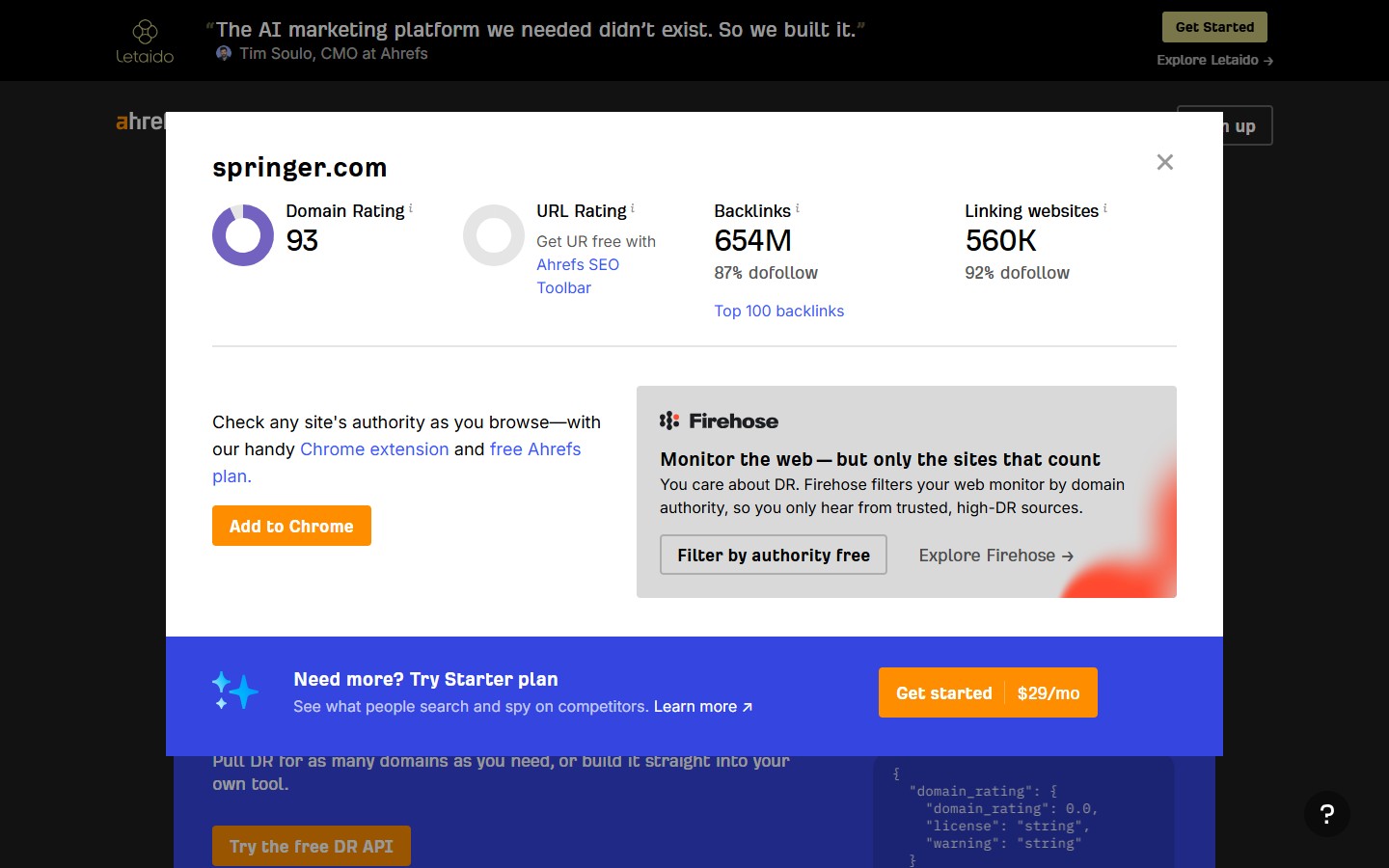
One of those numbers is Domain Rating (DR), developed by Ahrefs. It ranges from 0 to 100 and measures the relative strength of a website's backlink profile.
I used Ahrefs for a practical reason: its Website Authority Checker is publicly available for free, allowing the same measurement to be applied consistently across publisher websites. More importantly, the tool reports not only DR but also the backlinks and linking websites behind that score.
There is, however, a very important disclaimer.
Domain Rating is not a Google ranking factor.
It is an Ahrefs metric, not a score assigned by Google. It should therefore not be interpreted as evidence that Google automatically prefers a DR 93 website over a DR 83 website.
What DR gives us is something narrower: an indication of the relative strength of the backlink ecosystem surrounding a domain.
So I became curious.
I checked the websites of five major publishers where my own research has appeared. Using the homepage domain of each publisher in the free Ahrefs Website Authority Checker, this is what I found:
| Publisher | Domain Rating | Backlinks | Linking Websites |
|---|---|---|---|
| Springer | 93 | 635 million 90% dofollow |
560,000 92% dofollow |
| Elsevier | 93 | 203 million 90% dofollow |
342,000 92% dofollow |
| Wiley | 93 | 242 million 94% dofollow |
502,000 92% dofollow |
| Taylor & Francis | 83 | 3.6 million 97% dofollow |
23,000 84% dofollow |
| SAGE | 83 | 3.1 million 87% dofollow |
38,000 81% dofollow |
Source: Ahrefs Website Authority Checker. Measurements taken August 14, 2026, using each publisher's homepage domain. Values are snapshots and may change over time.
The More Interesting Numbers Are Not 93 and 83
At first glance, the Domain Ratings attract attention.
Springer, Elsevier, and Wiley all sit at 93. Taylor & Francis and SAGE sit at 83.
But look at the next two columns.
Springer's domain has approximately 635 million backlinks from 560,000 linking websites. Wiley has approximately 242 million backlinks from 502,000 websites. Elsevier has approximately 203 million backlinks from 342,000 websites.
Those numbers help explain what a strong web ecosystem actually looks like.
And they made me realize something rather amusing.
I did not build any of that.
I did not convince hundreds of thousands of websites to link to Springer.
I did not spend decades developing Wiley's web presence.
I did not wake up every morning wondering how Elsevier's backlink profile was doing.
I just arrived with a manuscript.
Yet when one of my papers is published there, it becomes part of that much larger digital environment.
A DR of 93 Does Not Make My Paper 93% Good
This distinction is important.
If one of my papers happens to live on a DR 93 domain, that says absolutely nothing about whether the paper itself is good.
Ahrefs has not evaluated my theoretical framework.
It has not examined my methodology.
It has not checked my statistical analysis.
It has certainly never met Reviewer 2.
Domain Rating describes characteristics of the domain surrounding the research, particularly its backlink profile.
Nor does every article somehow inherit a DR of 93.
Search engines evaluate individual pages and their relevance using many signals. A powerful publisher domain is therefore not a magic ranking ticket.
That is why the backlinks and linking websites in the table are perhaps more interesting than the score itself.
They illustrate the enormous web ecosystem in which these publishers operate.
The paper has not become better because of its address.
But its address exists within a much larger digital neighborhood.
I Can See the Question in My Own Papers
Consider my work on artificial intelligence.
In 2024, I published The Paradox of Artificial Creativity: Challenges and Opportunities of Generative AI Artistry.
Someone interested in that subject does not need to know my name or the title of my paper.
They might simply search:
Can artificial intelligence be creative?
Or:
What are the challenges of generative AI art?
Or perhaps:
How does generative AI affect human creativity?
That is what makes discoverability interesting.
The researcher is not necessarily searching for my paper.
They are searching for an answer.
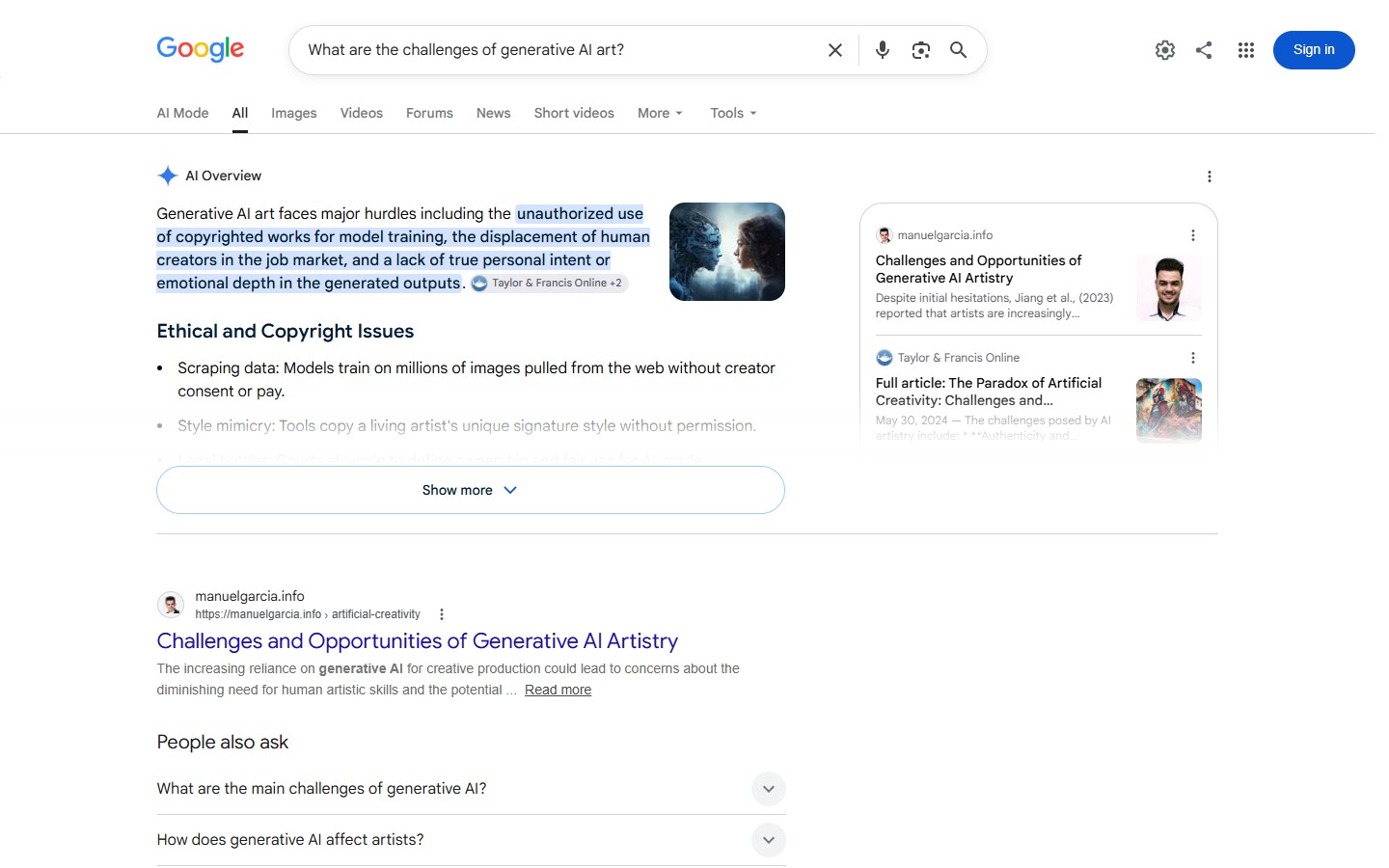
The same applies to my work in educational technology, including research published through Springer and other major academic publishers. A researcher may not know that a particular study exists. They know only the problem they are trying to understand.
Somewhere between that question and the eventual literature review, a discovery system has to connect the two.
Before Citation Comes Discovery
I have started thinking about citations almost as a sequence:
Someone has a question.
They search for an answer.
A paper appears.
The title and abstract look relevant.
They read it.
The research is useful.
They cite it.
Of course, discovery is only one part of the citation story. I have written elsewhere about how I structure connected research programs that sometimes lead several of my papers to be cited within the same article. Here, however, I am interested in what happens even earlier: how one of those papers gets found in the first place.
We academics tend to focus intensely on the last step because that is the number appearing on Google Scholar, Scopus, or Web of Science.
But SEO operates much closer to the top.
It cannot make an irrelevant paper relevant.
It cannot make weak research strong.
It cannot force anyone to cite anything.
It can only affect the opportunities for a paper to enter someone's field of view.
And there is something almost embarrassingly obvious about this:
Except Search Is No Longer Just Search
But the SEO I learned as a blogger is evolving.
During my college blogging days, the mental model was relatively straightforward...
Someone types keywords into Google.
Google produces a list of links.
You desperately hope your page is somewhere near the top.
Preferably before page two, otherwise you may as well have buried it in the backyard.
But search is changing.
People increasingly ask complete questions rather than typing short combinations of keywords. Search engines themselves increasingly provide AI-generated answers. Google now incorporates AI Overviews and AI Mode, while other AI systems similarly retrieve and synthesize information in response to questions.
And that changes what it means to be discoverable.
SEO Is Not Dead. AI Actually Makes This More Interesting.
It would be tempting to assume that AI makes SEO irrelevant.
If an AI system can understand a question and find the answer, who cares about traditional search optimization?
But Google's own guidance suggests otherwise.
The company says that the fundamental SEO practices used for ordinary Google Search continue to apply to its AI experiences. Pages still need to be accessible, crawlable, indexable, and understandable to search systems.
Google's AI search can also use what it calls query fan-out: rather than relying only on the original question, the system can perform multiple related searches across subtopics and sources to find information useful for constructing an answer.
That changes the question from:
Does my paper rank for this exact keyword?
to something potentially more interesting:
Can a search system recognize that my paper contains an answer relevant to someone's question?
For academic research, that could become increasingly important.
Perhaps We Are Moving from Keyword Discovery to Answer Discovery
Think again about The Paradox of Artificial Creativity.
A traditional SEO mindset might ask whether the article ranks for keywords such as generative AI creativity or AI artistry.
Those things still matter.
But an AI-mediated search may begin with a much more natural question:
What happens to human creativity when machines can generate art?
An intelligent retrieval system may then search related concepts and identify pages containing useful evidence or arguments.
The exact phrase does not necessarily need to appear everywhere.
What increasingly matters is whether machines can understand what the paper is about, what questions it addresses, and what contribution it makes.
In that sense, perhaps the future of academic SEO is less about awkwardly repeating keywords and more about something academics should already be doing:
Writing clearly about the question we are answering.
What a revolutionary idea.
And Then There Is Google Scholar
Of course, academic discovery has another important layer.
Google Scholar is not simply ordinary Google with more PDFs.
For scholarly material, Google needs to identify, crawl, and process academic content correctly. When multiple versions of a paper exist, Google Scholar can group those versions and identify the publisher's authoritative version.
This means the publisher's technical infrastructure matters in ways that are largely invisible to authors.
Metadata matters.
Crawlability matters.
Indexability matters.
The relationship between different versions of a paper matters.
We submit a manuscript and, eventually, a DOI appears.
Underneath that apparently simple process is an infrastructure helping machines understand:
This is a scholarly article.
This is its title.
These are its authors.
This is its abstract.
These are its references.
This is the authoritative version.
That is discoverability too.
So Should We Just Choose the Publisher with the Highest DR?
No.
Please do not finish reading this post, sort publishers by Domain Rating, and declare your journal-selection strategy complete.
That would turn a modest observation into spectacularly bad academic advice.
Remember the scope of this reflection:
We are talking only about SEO and discoverability here.
Journal selection involves many other considerations: scholarly fit, editorial quality, peer review, readership, indexing, reputation, publication ethics, accessibility, cost, and many others. I have discussed some of these practical considerations in Do I Need to Pay to Publish My Research in Journals?, particularly the relationship between publication fees, publishing models, and indexing.
A specialized journal on a smaller domain may be exactly where the researchers who need your work are looking.
A DR 93 publisher cannot compensate for a paper that does not answer the question a researcher is asking.
Nor does a DR 83 domain mean that a paper is difficult to discover. In fact, 83 itself represents a very strong backlink profile.
My argument is much smaller.
When we choose a publisher, we are also choosing part of the digital infrastructure through which our research will eventually be discovered.
That infrastructure probably deserves to be noticed.
Maybe the Publisher Is Our Digital Landlord
This has changed how I think about publishers, at least slightly.
Academically, the publisher facilitates peer review, production, dissemination, and preservation.
Digitally, however, the publisher is also something like our paper's landlord.
Our article gets an address on its property.
It becomes part of its website architecture.
It sits among its internal links, metadata systems, journal pages, references, related articles, and millions of other pieces of scholarly content.
And like real estate, apparently location matters.
I did not expect my college blogging days and academic publishing career to eventually meet in a discussion about digital real estate, but here we are.
Timing Gets You Into the Conversation. Discoverability Helps People Find You.
This brings me back to my previous reflection.
There, I wrote about the importance of timing.
A timely paper enters the world when people are already asking its question.
But what do people do when they have a question?
They search.
Perhaps they search Google Scholar.
Perhaps Google.
Perhaps a scholarly database.
Increasingly, perhaps they ask an AI system.
Whatever the interface, some mechanism still has to connect the question with the research.
And that gives me a useful companion to the lesson from my previous reflection:
Timing influences whether people are looking.
Discoverability influences whether they find you.
What happens afterward still depends on the paper.
It has to be relevant.
It has to be credible.
It has to be useful.
It has to contribute something worth carrying forward.
SEO cannot do those things for us.
Nor should we want it to.
A Question Worth Searching
Academic life trains us to ask many questions before submitting a manuscript.
Is this journal reputable?
Does my paper fit its scope?
Is it indexed?
Will the right scholarly community read it?
Is this the right audience?
Perhaps there is another, quieter question worth adding:
If someone does not already know that my paper exists, how likely are they to find it?
That is why the question "Why isn't my paper getting cited?" may sometimes have another question hiding underneath it:
"Is my paper being found in the first place?"
That question is becoming more interesting as search evolves.
The researcher of tomorrow may not search for our carefully selected keywords.
They may simply ask a question.
And somewhere between that question and the answer, a search engine, scholarly database, or AI system will retrieve some pieces of scholarship and not others.
We cannot control that process completely.
But we can recognize that scholarly communication does not end when a paper is published.
Publication gives research an existence.
Discoverability gives it an opportunity to travel.
Closing: From Blogging to Publishing
There is something strangely satisfying about returning to a lesson I first encountered as a college blogger.
Back then, I wanted people to find what I wrote.
Today, the writing is different. The stakes are different. The audience is different. And instead of wondering whether anyone will read my latest blog post, I am wondering whether another researcher somewhere will encounter a paper that might help answer a question they are working on.
But perhaps the underlying principle has not changed very much.
Writing something worth reading and making it possible to find are two different tasks.
My previous reflection was about meeting the right moment.
Perhaps this one is about being findable when that moment arrives.
Good research still has to be found before it can be read.
And it has to be read before it can be cited.
Publish with purpose.
But perhaps pay a little attention to the address.