
Crossing the 4,000-Citation Milestone on Google Scholar: When the Snowball Starts Rolling
My Google Scholar profile surpassed 4,000 citations in March 2026. Explore the research, collaborations, and publications behind this milestone.
Surpassing 4,000 citations on Google Scholar feels a bit like watching a snowball roll downhill. At first, you push it slowly and wonder whether it will even move. Then it starts gathering speed, and before you know it, it has grown much bigger than you ever expected.
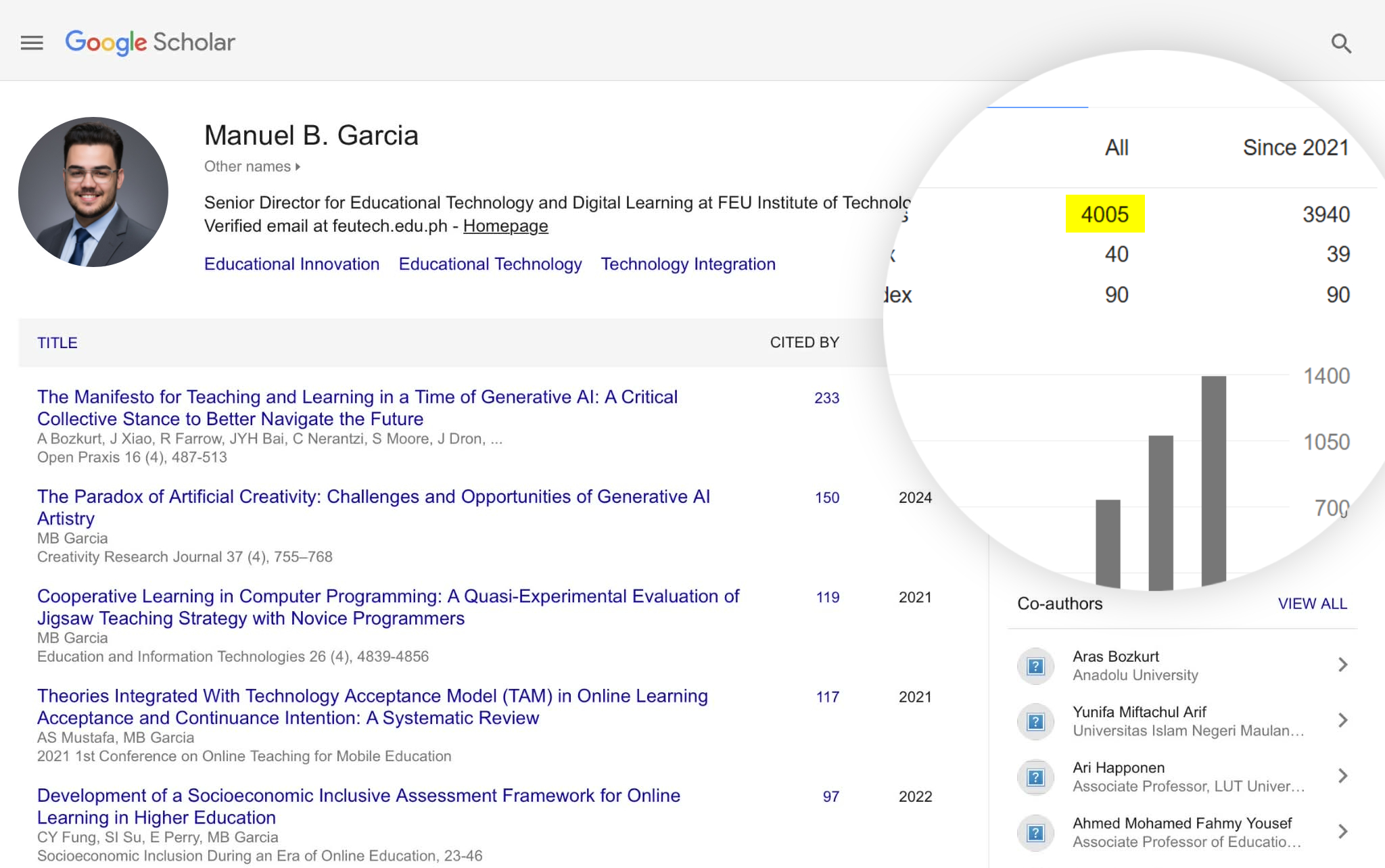
On March 14, 2026, my Google Scholar profile reached 4,005 citations, marking another milestone in a research journey that began with my first publication in 2017.
Just seven months ago, I shared that I had reached 3,000 citations. At the time, I joked about how quickly the numbers seemed to be increasing. Well, apparently the academic citation engine decided to shift into an even higher gear.
If this trend continues, I might need to start refreshing Google Scholar with the same nervous energy people reserve for checking cryptocurrency prices. But jokes aside, this milestone is less about the number itself and more about what it represents: a growing community of researchers encountering, discussing, and building upon my published work.
The Acceleration Is Real
One of the most interesting aspects of this journey has been observing how the time between citation milestones has changed.
My first 1,000 citations took approximately six years from my initial publication in 2017. The second thousand arrived in just nine months and 24 days. The third followed after another 11 months and 16 days. Now, the fourth thousand has arrived in only seven months and three days.
Of course, citation growth does not necessarily follow a predictable trajectory. Publication volume, research visibility, collaboration networks, and interest in particular topics can all influence how frequently scholarly work is cited. Nevertheless, the acceleration has been encouraging, especially when I remember how long it took to reach the first thousand.
It turns out that research visibility can sometimes resemble compound interest. Earlier publications continue attracting attention while newer studies contribute additional citations. Unlike a savings account, however, Google Scholar offers no guaranteed rate of return.
The Power of Timely Topics and Collective Effort
Much of the recent scholarly attention to my work has involved research at the intersection of education, technology, and emerging digital tools, particularly generative artificial intelligence.
One notable example is The Manifesto for Teaching and Learning in a Time of Generative AI: A Critical Collective Stance to Better Navigate the Future.
When I reached the 3,000-citation milestone in August 2025, this collaborative paper had accumulated 75 citations. By March 2026, that figure had increased to 233 citations, making it my most-cited publication at the time.
That is an additional 158 citations in just over seven months. Watching a publication attract this much scholarly attention in a relatively short period has been both surprising and encouraging.
Beyond the numbers, what makes this paper particularly meaningful is the international collaboration behind it. Bringing together researchers from different institutions and educational contexts to examine the implications of generative AI required considerable coordination and intellectual exchange. The growing interest in the publication suggests that these questions continue to occupy an important place in educational research.
Another study that has attracted substantial attention is The Paradox of Artificial Creativity: Challenges and Opportunities of Generative AI Artistry. Published in 2024, the paper had accumulated 150 citations by this milestone.
Its citation growth reflects considerable scholarly interest in the relationship between artificial intelligence and creativity, particularly as generative technologies challenge established assumptions about authorship, originality, and creative practice.
Interestingly, these publications also illustrate how research on emerging technologies can attract attention at different rates. Some studies gain visibility relatively quickly because they address rapidly developing questions, while others continue accumulating citations over longer periods.
In other words, some papers sprint while others run marathons. The important thing is that they contribute something worthwhile along the way.
The Journey So Far
Since reaching my first 1,000 citations in November 2023, I have been keeping a historical record of my Google Scholar milestones. With four thousand citations now reached, the progression provides an interesting picture of how my research profile has developed over time.
| Google Scholar Metrics | 1,000 | 2,000 | 3,000 | 4,000 |
|---|---|---|---|---|
| Publications | 69 | 89 | 120 | 139 |
| Citations | 1,001 | 2,001 | 3,001 | 4,005 |
| h-index | 19 | 32 | 37 | 40 |
| i10-index | 44 | 64 | 79 | 90 |
| Date | November 2, 2023 | August 26, 2024 | August 11, 2025 | March 14, 2026 |
Note: The figures reflect historical Google Scholar screenshots recorded at each milestone, rather than current citation metrics. Dates correspond to the documented milestone announcements. Click the citation milestone headings to read their corresponding articles.
Looking at these milestones, the most noticeable development is how the intervals between them have changed. The first thousand required approximately six years, followed by nine months and 24 days for the second, 11 months and 16 days for the third, and just seven months and three days for the fourth.
Interestingly, the latest thousand arrived faster than either of the previous two. From my first documented milestone in November 2023 to March 2026, my citation count has increased from 1,001 to 4,005, while my h-index has risen from 19 to 40 and my i10-index from 44 to 90.
These changes suggest that scholarly attention has extended across an increasing number of publications. Still, citation metrics should be interpreted carefully. They reflect patterns of scholarly referencing rather than directly measuring research quality, originality, or practical impact. For me, maintaining this record is primarily a way to document how my published work continues to circulate within the academic community.
Research Is Still a Team Sport
If there is one recurring theme throughout this journey, it is the importance of collaboration.
Research might look like a solitary activity from the outside. Just a person, a laptop, and far too many browser tabs. In reality, much of the work develops through discussions, shared expertise, constructive criticism, and the contributions of people who approach the same problem from different perspectives.
Co-authors help refine ideas and strengthen research designs. Reviewers identify weaknesses that might otherwise go unnoticed. Editors facilitate scholarly communication, while readers and subsequent researchers determine how published findings might inform new investigations.
Not every citation necessarily represents agreement, of course. Sometimes a study is cited precisely because another researcher wishes to question its assumptions or challenge its conclusions. That, too, is part of how scholarship progresses.
What matters is that research remains part of an ongoing conversation rather than ending when a paper is published.
Open Invitation: Let's Work Together
If you have ever thought, "Hmm, I would like to work on something interesting, meaningful, and perhaps a little unconventional," then consider this your official invitation.
I remain open to research collaborations, whether you are across the hall, across the country, or across the globe. Some of my most rewarding research experiences have come from working with colleagues whose expertise and perspectives differ from my own.
To illustrate how collaboration has shaped my research portfolio, here is a snapshot of my publications and citations by authorship position at this milestone:
- Solo Author – 37 papers (26.6%) | 1,191 citations | Avg: 32 citations/paper
- First Author – 45 papers (32.4%) | 1,141 citations | Avg: 25 citations/paper
- Co-Author – 23 papers (16.5%) | 733 citations | Avg: 32 citations/paper
- Last Author – 34 papers (24.5%) | 940 citations | Avg: 28 citations/paper
These figures illustrate the different roles I have taken across my research projects. Some studies were conducted independently, others involved leading collaborative work, and many benefited from contributing alongside researchers with complementary expertise.
Authorship position does not always capture the full nature of an individual's contribution, particularly across disciplines with different authorship conventions. Nevertheless, the distribution offers a useful perspective on the range of research activities represented in my publication record.
What I find particularly encouraging is that scholarly attention is not limited to one authorship role. Research conducted independently and work developed collaboratively have both contributed to these milestones.
If our research interests align, I would be glad to explore the possibility of working together on future projects.
Onward to the Next Chapter
When I published my first paper in 2017, reaching 4,000 citations was certainly not part of my original plan. I was simply trying to contribute something meaningful to the literature and learn how to become a better researcher.
Nearly nine years later, that motivation remains largely unchanged. I want to continue investigating worthwhile questions, collaborating with people who challenge my thinking, and producing research that others may find useful.
Of course, I appreciate every citation milestone along the way. They provide moments to reflect on the journey and acknowledge the people who have helped shape it. But the numbers themselves are not the destination.
To everyone who has collaborated with me, cited my publications, reviewed a manuscript, debated an idea, or simply read a few paragraphs before deciding that the paper was not quite what you needed, thank you.
As for the next thousand citations, I suppose we will see how long they take. Given how unpredictable academic publishing can be, I am not making any forecasts just yet.
Besides, I would rather spend my time writing the next paper than refreshing Google Scholar every five minutes.
Although, admittedly, I might still check occasionally.
Here is to the next research question, the next collaboration, and the next idea worth pursuing.
You can explore my published research through my publications page or visit my Google Scholar profile for my latest citation indicators.