
Crossing the 5000-Citation Milestone on Google Scholar: A Long Way from That First Research Paper
From one research paper in 2017 to 5,000 Google Scholar citations in 2026, I reflect on nearly a decade of scholarly contributions and collaboration.
Back in 2017, I had one simple ambition: publish a research paper in a journal. Just one. I wanted to see my name on a published study, contribute something to the academic literature, and perhaps convince myself that I actually knew what I was doing.
Nearly a decade later, on October 27, 2026, my Google Scholar profile crossed 5,000 citations, reaching 5,021 citations, an h-index of 42, and an i10-index of 102.
Not bad for someone who just wanted to publish one paper!
When I reached my first 1,000 citations in November 2023, it had taken approximately six years since my first publication. The next thousand arrived in less than ten months, followed by another in just under a year. By March 2026, I had reached 4,000 citations. And now, seven months and 13 days later, another thousand has joined the count.
At this point, I am beginning to suspect that Google Scholar is trying to keep me busy writing milestone articles instead of research papers. But jokes aside, reaching 5,000 citations is a meaningful occasion to reflect on how far this journey has come, the people who have contributed to it, and the research questions that continue to make the work worthwhile.
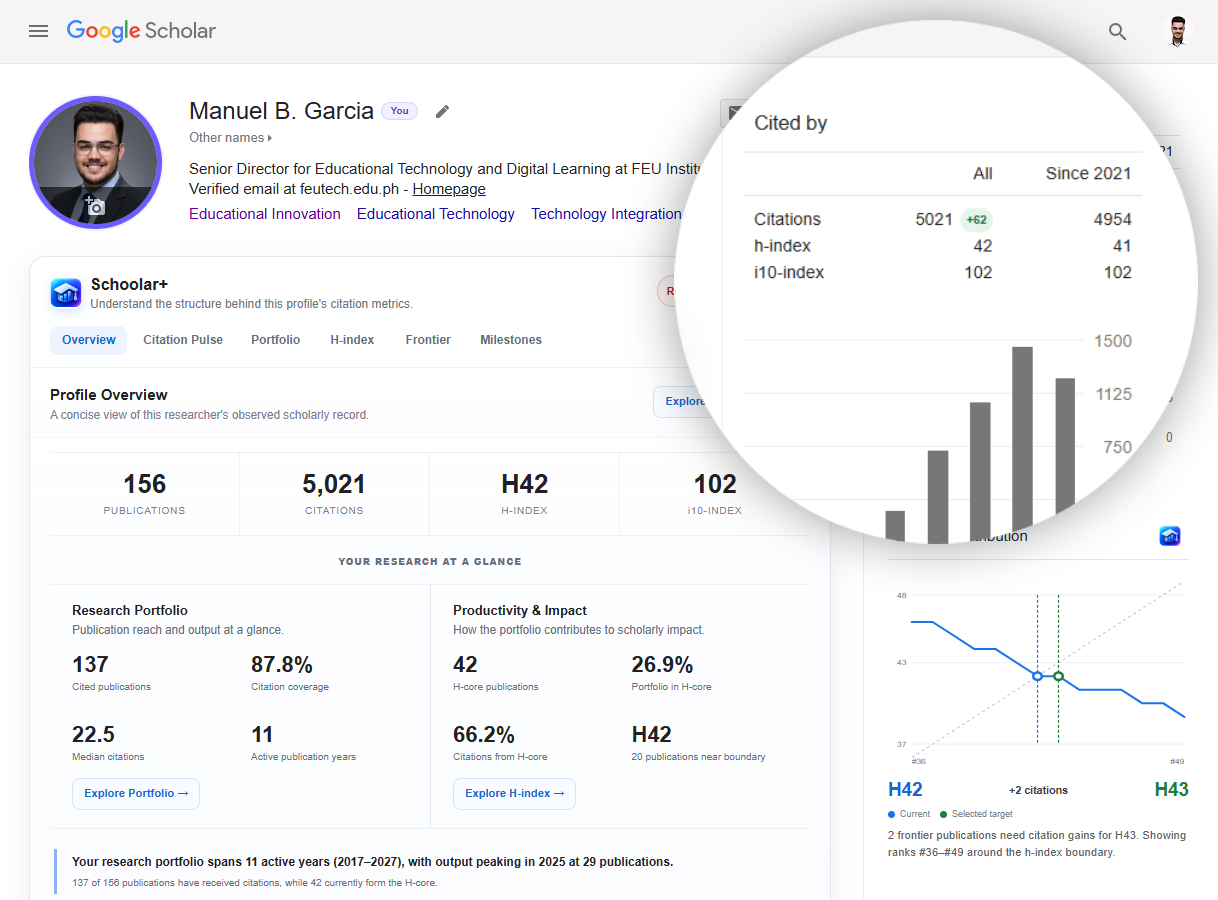
From One Paper to Five Thousand Citations
When I published my first research paper in 2017, I was not thinking about citation counts, h-indices, or how my research profile might look nearly ten years later. My immediate concern was considerably simpler: could I successfully conduct a study, write it up, and get it published?
Anyone who has experienced academic publishing knows that even this seemingly modest goal can become quite an adventure. There are research questions to refine, methodologies to defend, findings to interpret, and manuscripts to revise. And just when you think everything is finally ready, Reviewer 2 occasionally reminds you that your definition of "finished" is merely a suggestion.
But that first publication opened the door to more questions. Over time, my research interests developed across educational technology, information technology, digital learning, and emerging technologies. Some studies addressed practical educational challenges, while others explored how technological developments might influence teaching, learning, and broader scholarly practices.
One paper eventually became several, and those publications gradually became part of other researchers' work. Some attracted attention relatively quickly, while others accumulated citations more slowly. There was no single moment when everything suddenly changed, although looking back at the numbers makes the progression rather interesting.
What began as an attempt to publish one paper has become a continuing commitment to asking questions, examining evidence, and contributing to scholarly conversations that extend well beyond my own institution.
The Journey So Far
Since reaching my first 1,000 citations in November 2023, I have been documenting my Google Scholar milestones as a historical record of how my research profile has developed. With the fifth thousand now reached, the table has grown considerably from where it began.
| Google Scholar Metrics | 1,000 | 2,000 | 3,000 | 4,000 | 5,000 |
|---|---|---|---|---|---|
| Publications | 69 | 89 | 120 | 139 | 159 |
| Citations | 1,001 | 2,001 | 3,001 | 4,005 | 5,021 |
| h-index | 19 | 32 | 37 | 40 | 42 |
| i10-index | 44 | 64 | 79 | 90 | 102 |
| Date | November 2, 2023 | August 26, 2024 | August 11, 2025 | March 14, 2026 | October 27, 2026 |
Note: The figures reflect historical Google Scholar screenshots recorded at each milestone, rather than current citation metrics. Dates correspond to the documented milestone announcements. Click the citation milestone headings to read their corresponding articles.
Looking at this progression, the first thousand remains the longest journey, taking approximately six years from my first publication in 2017. The second thousand arrived nine months and 24 days later, followed by the third after 11 months and 16 days. The fourth took seven months and three days, while the fifth arrived in seven months and 13 days.
Interestingly, the latest thousand took only ten days longer than the previous one. Apparently, even citation growth has decided to settle into something resembling a routine. Whether that continues is another question entirely.
What I find particularly encouraging is the development of the other research indicators. From November 2023 to October 2026, my h-index increased from 19 to 42, while my i10-index rose from 44 to 102. These changes indicate that a growing number of my publications have reached the citation thresholds represented by these measures.
Of course, bibliometric indicators should be interpreted with care. Citation counts are influenced by publication age, disciplinary practices, collaboration patterns, and the visibility of particular research topics. They do not independently establish the quality, originality, or societal impact of scholarly work. Nevertheless, maintaining this historical record provides an opportunity to reflect on how my publications have continued to attract academic attention over time.
Some Papers Have Really Taken Off
One of the most interesting developments since my previous milestone has been the continued citation growth of several publications, particularly those examining generative artificial intelligence and its implications for education and creativity.
When I reached 4,000 citations in March 2026, The Manifesto for Teaching and Learning in a Time of Generative AI: A Critical Collective Stance to Better Navigate the Future had accumulated 233 citations. By October 2026, that figure had increased to 402 citations, an additional 169 citations in just over seven months.
What makes this publication especially meaningful is the international collaboration behind it. Bringing together 47 authors from 41 institutions across 20 countries was an ambitious undertaking, particularly when addressing a subject as complex and rapidly evolving as generative AI in education.
Apparently, coordinating that many researchers was not the only challenge. The paper also had to find its way into an academic conversation that was changing almost as quickly as the technology itself.
Another publication that has continued attracting scholarly attention is The Paradox of Artificial Creativity: Challenges and Opportunities of Generative AI Artistry.
At the 4,000-citation milestone, this paper had accumulated 150 citations. Seven months later, it had reached 270 citations, an increase of 120.
Its continued citation growth suggests substantial scholarly interest in questions surrounding artificial intelligence, creativity, authorship, and originality. These are issues that extend beyond technological capabilities and raise important questions about how creative work is understood, produced, and evaluated.
What I find particularly interesting is that these two publications approach generative AI from different perspectives, yet both have attracted considerable attention. One examines the implications of generative AI for teaching and learning, while the other considers its relationship with creative practice.
Meanwhile, earlier publications continue contributing to the citation record. My 2021 study on cooperative learning in computer programming has reached 129 citations, while my research on technology acceptance in online learning has accumulated 142 citations.
These developments remind me that research does not necessarily follow a predictable timeline. Some publications gain attention quickly because they address emerging issues, while others remain relevant as researchers revisit established educational and technological challenges.
In other words, some papers sprint, others run marathons, and a few apparently decide to do both.
Research Is Still a Team Sport
Although citation milestones are often associated with individual researchers, the work behind them is rarely an entirely individual undertaking.
Research involves conversations, disagreements, shared expertise, and the contributions of people who approach similar problems from different perspectives. Co-authors help develop ideas and strengthen methodologies. Reviewers challenge assumptions and identify weaknesses. Editors facilitate scholarly communication, while readers and subsequent researchers determine how published work might inform further investigations.
Even when a paper has only one author, its development is influenced by a much broader scholarly community. No research exists entirely in isolation, regardless of how many hours its author spends alone in front of a computer.
And believe me, those hours can add up.
One of the lessons I continue to appreciate is that meaningful research can emerge through different forms of authorship and collaboration. Some projects benefit from independent investigation, while others require expertise that no single researcher could reasonably provide.
What matters is the contribution being made, the integrity of the research process, and the willingness to engage with ideas beyond one's own perspective.
Open Invitation: Let's Work Together
If you have ever thought, "Hmm, I would like to work on something interesting, meaningful, and perhaps a little unconventional," then consider this your official invitation.
I remain open to research collaborations, whether you are across the hall, across the country, or across the globe. Some of my most rewarding experiences have come from working with researchers whose expertise and perspectives differ from my own.
To illustrate how my research portfolio has developed, here is the distribution of my publications and citations by authorship position at the 5,000-citation milestone:
- Solo Author – 45 papers (28.3%) | 1,556 citations | Avg: 34.58 citations/paper
- First Author – 48 papers (30.19%) | 1,350 citations | Avg: 28.13 citations/paper
- Co-Author – 28 papers (17.61%) | 1,025 citations | Avg: 36.61 citations/paper
- Last Author – 38 papers (23.9%) | 1,065 citations | Avg: 28.03 citations/paper
Across these categories, the record includes 159 publications and 4,996 citations attributed through this authorship-based analysis. The small difference from the Google Scholar total of 5,021 reflects that these are separate reporting snapshots or calculations, rather than an exact reconciliation of the same dataset.
What I find particularly interesting is that the highest average citation count per paper appears in the co-author category, at 36.61 citations per publication, followed by independently authored work at 34.58 citations per publication.
Of course, these differences should not be interpreted as evidence that one authorship position produces better research. Publication age, subject area, research visibility, and the characteristics of individual studies may all influence citation averages. Authorship conventions also vary across disciplines, making direct comparisons less straightforward than the numbers might suggest.
Nevertheless, the distribution illustrates the different roles I have taken throughout my research journey. Some studies were conducted independently, others involved leading collaborative projects, and many benefited from contributing alongside colleagues with complementary expertise.
For me, collaboration is not simply about increasing publication counts or citation indicators. It is about working with people who can challenge assumptions, contribute different methodological perspectives, and help investigate questions that would be difficult to address alone.
So, if our research interests align, I would be glad to explore the possibility of working together.
Preferably on a project where we can agree on the manuscript title before the third round of revisions.
Five Thousand Citations Later, What Has Changed?
Looking back at my first publication in 2017, I sometimes wonder what I would have thought if someone had told me that my research would eventually accumulate more than 5,000 citations.
I probably would have asked whether they were confusing my Google Scholar profile with someone else's.
But beyond the humor, this milestone has encouraged me to reflect on how my understanding of research has changed over the years.
Early in my research journey, publishing a paper felt like the achievement itself. Over time, I came to appreciate that publication is only one part of a much longer process. Research becomes particularly meaningful when its findings are examined, questioned, applied, extended, or used to inform subsequent investigations.
At the same time, I have become increasingly conscious of the limitations of measuring scholarly contribution through citations alone. A publication may attract considerable academic attention without necessarily producing an equivalent practical impact. Conversely, research that informs educational practice, supports institutional decisions, or helps address local problems may be valuable even when its citation count remains relatively modest.
This distinction matters particularly in educational technology, where the ultimate value of research should include what it contributes to teaching, learning, and the experiences of educators and students.
For that reason, while I appreciate reaching 5,000 citations, I hope to continue evaluating my work through questions that cannot be answered by Google Scholar alone. Has the research contributed useful knowledge? Has it helped others investigate important problems? Has it opened opportunities for meaningful collaboration or practical improvement?
Those questions are considerably more difficult to quantify, but they are worth asking.
Onward to the Next Chapter
Five thousand citations. Nearly a decade since my first publication. And somehow, I am still asking many of the same questions that motivated me to begin conducting research in the first place.
The difference is that I now have a much greater appreciation for the people, processes, and occasional frustrations that make scholarly work possible.
I remain grateful to the colleagues, collaborators, mentors, students, reviewers, and fellow researchers who have contributed to this journey. Whether you have worked with me on a publication, cited one of my studies, offered constructive criticism, or simply taken the time to engage with my research, thank you.
I am particularly grateful for the opportunities to work with researchers from different institutions and countries. These collaborations have expanded my perspectives and reminded me that some of the most interesting questions emerge when people with different experiences examine the same problem.
As for the next milestone, I am not making any predictions. The last few years have already demonstrated that citation growth can be surprisingly unpredictable, and I would rather concentrate on producing worthwhile research than trying to forecast what Google Scholar will display next.
Besides, I still have manuscripts to finish, research questions to investigate, and probably a few reviewer comments waiting somewhere in my inbox.
And to think that all of this started because I wanted to publish just one paper.
Here is to the next meaningful question, the next worthwhile collaboration, and whatever the research journey brings next.
Feel free to explore my published research through my publications page or visit my Google Scholar profile to see the work behind these milestones and my latest citation indicators.