How to Increase Your H-Index Without Gaming the Metric: A Smarter Way to Look at Your Citation Portfolio
I have a confession: I have been tracking my h-index manually through a private application I built for myself for years.
Not obsessively, I would like to think. Although anyone who has ever created a spreadsheet specifically to calculate how many citations individual papers need before the next h-index probably loses the right to define the word “obsessively.”
I started doing this because the h-index behaves differently from total citations. Watching your Google Scholar citation count climb is straightforward. If you gain 100 citations, congratulations, you have 100 more citations. The h-index is fussier. You can gain hundreds of citations and still remain at exactly the same h-index.
That is because the h-index does not really care how impressive your most-cited paper looks. It cares about the citation distribution across a particular part of your publication portfolio.
Once I understood that, I stopped looking at my h-index merely as a number and started looking at what I call the citation frontier: the papers sitting around the boundary between my current h-index and the next one.
First, Understand What Actually Makes Your H-Index Increase
The h-index was proposed by physicist Jorge Hirsch in 2005. In simple terms, you have an h-index of h when at least h of your papers have received at least h citations each.
If your h-index is 20, for example, you have at least 20 publications with 20 or more citations.
To reach H21, you need 21 publications with at least 21 citations each.
That sounds obvious when written down. Its implications are less obvious.
Suppose your most-cited paper jumps from 500 citations to 600. Wonderful. That is another 100 citations, more evidence that the paper is being used, and possibly something worth celebrating. But if your 21st-ranked paper still has only 18 citations, that extra 100 citations on the first paper does nothing by itself to move you from H20 to H21.
Meanwhile, three additional citations to that 21st paper might matter directly.
This is why two researchers with the same total citation count can have very different h-indices, and why the same researcher can accumulate many new citations without immediately seeing the h-index change. The metric is sensitive not only to how many citations you have, but to where those citations are distributed across your papers.
The Papers Near the Boundary Are the Interesting Ones
This is where my old manual tracker came in.
If I was at H37, I would not spend much analytical attention on a paper with 300 citations. That paper had already done far more than H37 required from it.
I would look instead at publications ranked around #38, #39, #40, and so forth.
Perhaps the picture looked something like this:
| Rank | Citations | For H38 |
|---|---|---|
| #36 | 51 | Already above threshold |
| #37 | 44 | Already above threshold |
| #38 | 35 | Needs 3 citations |
| #39 | 31 | Below the immediate frontier |
Suddenly, H38 is no longer some mysterious number that Google Scholar will eventually award when the academic stars align. You can see the mathematical boundary.
This does not mean that I should somehow manufacture three citations for paper #38. It means that paper #38 is an interesting paper to examine.
Why has it received 35 citations? Who is using it? Is the topic still active? Does the paper contain an idea that deserves extension? Is there a newer question emerging from it? Is it difficult to find online? Have I continued developing the research program that produced it, or did I publish it and immediately run off to chase the next shiny research topic?
Those are legitimate research questions about your own body of work.
This Is Where Strategy Can Become Unethical, So Let Me Draw the Line
Whenever we talk about “increasing citations” or “increasing the h-index,” there is an obvious danger: the metric can become the goal.
That is backwards.
A citation should arise because another scholarly work has a legitimate reason to reference yours. Citation counts are traces of scholarly attention, not certificates of research quality. A highly cited paper is not automatically better, more correct, or more important than a less-cited one. Fields also differ enormously in their citation practices, publication rates, collaboration patterns, and audience sizes. This is one reason I have previously argued for looking beyond raw citation counts and considering contextualized indicators such as Field-Weighted Citation Impact when appropriate.
So I would not recommend writing unnecessary papers around your own work merely to create opportunities for self-citation. I would not recommend adding irrelevant references to your papers. I would certainly not recommend citation exchanges, citation cartels, or the charming academic equivalent of “you cite me and I’ll cite you.”
And if you are writing a new paper that genuinely builds on an earlier study of yours, cite that earlier study only when it serves the scholarship. The test is simple: would this reference still belong here if the earlier paper had been written by someone else?
If the answer is yes, the citation is probably doing legitimate intellectual work.
The ethical strategy is therefore not “How do I get three citations into this paper?”
It is:
“This paper is close to my citation frontier. Is there anything academically worthwhile I should be doing with the research it represents?”
Tip 1: Look for Papers That Deserve a Follow-Up
One of the most legitimate ways to build on an existing paper is exactly what researchers are supposed to do: continue the research.
A study may leave unanswered questions. Its limitations may suggest another design. A technology may have changed since the original data were collected. A finding may need replication in another population. A framework may be applicable to a new context.
If one of your frontier papers sits inside an active research program, that is useful information.
Imagine that you published a study on generative AI literacy three years ago and it is now approaching your h-index boundary. Since then, the technology, institutional policies, and research literature have changed substantially. A follow-up study might be scientifically justified regardless of what your h-index says.
The fact that the original paper happens to sit near your citation frontier is not a reason to manufacture another study. It is simply another signal telling you, “People have been engaging with this work. Perhaps there is more here worth investigating.”
Tip 2: Build Research Programs, Not Isolated Papers
I increasingly think this is one of the biggest differences between publishing papers and building a research portfolio.
An isolated paper asks a question, answers it, gets published, and then sits there.
A research program allows one study to generate the next question.
Study A identifies a phenomenon. Study B tests an explanation. Study C develops an intervention. Study D evaluates it in another context. A later review synthesizes what the sequence has taught us.
That continuity has an intellectual advantage: each paper becomes part of a recognizable conversation rather than an unrelated line on your CV.
It can also have a citation advantage, but that should be a consequence rather than the justification. Researchers who encounter one paper may discover the related work. Future studies have legitimate reasons to discuss earlier findings. Other scholars can see a coherent body of literature that they can engage with rather than a collection of academic one-night stands.
Tip 3: Make Sure the Paper Can Still Be Found
I have written before about SEO for academic publishing, and the basic principle remains wonderfully untechnical: before a paper can be cited, it has to be found.
This sounds painfully obvious, yet researchers sometimes treat publication as the end of dissemination. We spend months writing the manuscript, survive Reviewer 2, celebrate the acceptance email, share the link once on Facebook, and then apparently expect the global scholarly community to take it from there.
Look at your frontier papers and ask whether they are still discoverable.
- Does the title clearly communicate what the study is about?
- Are the important concepts represented in the title, abstract, and keywords?
- Is your Google Scholar profile accurate?
- Is there a legitimate open-access version available when copyright permits it?
- Is the publication listed on your institutional or personal research profile?
- Have you discussed the findings in talks, teaching, professional communities, or public scholarship where relevant?
Promoting research does not mean pestering strangers until they cite you. It means reducing unnecessary barriers between useful research and the people who might actually need it.
Tip 4: Revisit Older Work When the World Catches Up With It
One thing my most-cited papers have taught me is that timing matters, but timing is not always under our control.
I have written about this tension in Timeless Questions, Timely Moments: worthwhile research questions do not necessarily have to chase whatever topic happens to be fashionable this month, but the moment in which a paper enters the scholarly conversation can still shape how quickly it attracts attention.
A paper can be published before its topic becomes fashionable. Then something changes: a new technology appears, a policy debate emerges, a crisis makes an old question suddenly urgent, or an adjacent field discovers the same problem.
If one of your older frontier papers has become newly relevant, revisit it.
That might mean writing a follow-up study, discussing it in a conference presentation, connecting it to a newer literature, preparing a public-facing explanation, or simply making sure researchers searching the contemporary terminology can discover the earlier work.
The important point is not to pretend an old paper predicted the future. Academics have enough retrospective clairvoyance already. The point is to recognize when an earlier contribution has become relevant to a new scholarly conversation.
Tip 5: Pay Attention to the Papers Just Outside Your H-Core
Your h-core consists of the papers supporting your current h-index. If you are H42, there are 42 papers with at least 42 citations each.
The papers immediately outside that group are particularly informative.
Suppose publication #43 has 40 citations. It is only three citations away from satisfying the H43 threshold. But perhaps publication #44 has 19 citations and #45 has 17.
That tells you something about the shape of your citation portfolio. H43 may be relatively close, while H44 could require considerably more movement across multiple publications.
This is why I prefer looking at a frontier rather than obsessing over a single “citations needed” number. The frontier shows the papers around the boundary and lets you see whether citation attention is broadly distributed or whether the next threshold depends heavily on one or two publications.
Tip 6: Do Not Neglect Papers Just Because They Are Already Highly Cited
There is an important correction to everything I have said so far.
If your goal were purely to manipulate the h-index, you might conclude that citations to papers already far above the h-index are “wasted.” They are not.
A paper with 500 citations may be intellectually central to your research program. It may generate collaborations, influence practice, establish a method, or create the foundation for an entirely new line of work. Another citation to it may not change H42 to H43, but that does not make the citation meaningless.
This is exactly why the h-index should never become your complete model of research impact.
Total citations tell us something different. Citation distribution tells us something different. Field-normalized indicators tell us something different again. And none of them fully captures whether the work changed policy, improved teaching, influenced professional practice, created useful technology, or simply answered an important question well.
The frontier is useful for understanding the h-index. It is not a map of which papers matter.
Tip 7: Track the Frontier, but Do Not Let It Choose Your Research Questions
This may be the most important rule.
If I notice that a paper needs four citations to help move my h-index, that should not suddenly determine what I study next.
The research question still has to be worth answering.
Citation potential can be one piece of strategic information. Researchers operate in real institutions with promotion criteria, grant applications, rankings, performance reviews, and bibliometric indicators. Pretending that metrics do not exist is not necessarily more principled than understanding them.
But the metric should inform the strategy, not replace scientific judgment.
I would rather have an H42 built from work I am proud of than an H50 built from a decade of asking questions I did not care about.
What I Learned From Tracking My Own H-Index
I have been keeping an eye on this frontier long before I had a tool to visualize it properly.
When my Google Scholar profile crossed 2,000 citations, my h-index was 32. When I later crossed 3,000 citations, it had reached 37. Today, with more than 4,700 Google Scholar citations, it is 42.
The progression itself is interesting:
| Google Scholar milestone | H-index |
|---|---|
| 2,000+ citations | H32 |
| 3,000+ citations | H37 |
| 4,700+ citations | H42 |
Notice that another 1,000 or 1,700 citations does not translate into some fixed number of h-index points. It depends on where those citations land across the publication portfolio.
That is precisely why I maintained my own tracker. I wanted to know which papers were around the boundary, how many citations separated the current h-index from the next one, and whether the shape of the portfolio was changing.
It was useful.
It was also, I eventually realized, the sort of thing a computer should probably be doing instead of me.
The Easier Way I Use Now
That little tracking habit eventually became one of the ideas behind Schoolar+, the Chrome extension I built to add a deeper analytical layer to Google Scholar.
Instead of manually sorting publications and calculating the next h-index threshold, Schoolar+ can show the H-index Frontier directly on a Google Scholar profile. It identifies the current boundary, lets you inspect higher h-index targets, and shows which citation-ranked publications are below a selected threshold and by how much.
For example, if I am currently H42 and looking at H43, I can immediately see the publications around that frontier and the citation gaps involved. The point is not to tell me which papers I should somehow get cited. It is to help me understand the structure behind the metric.
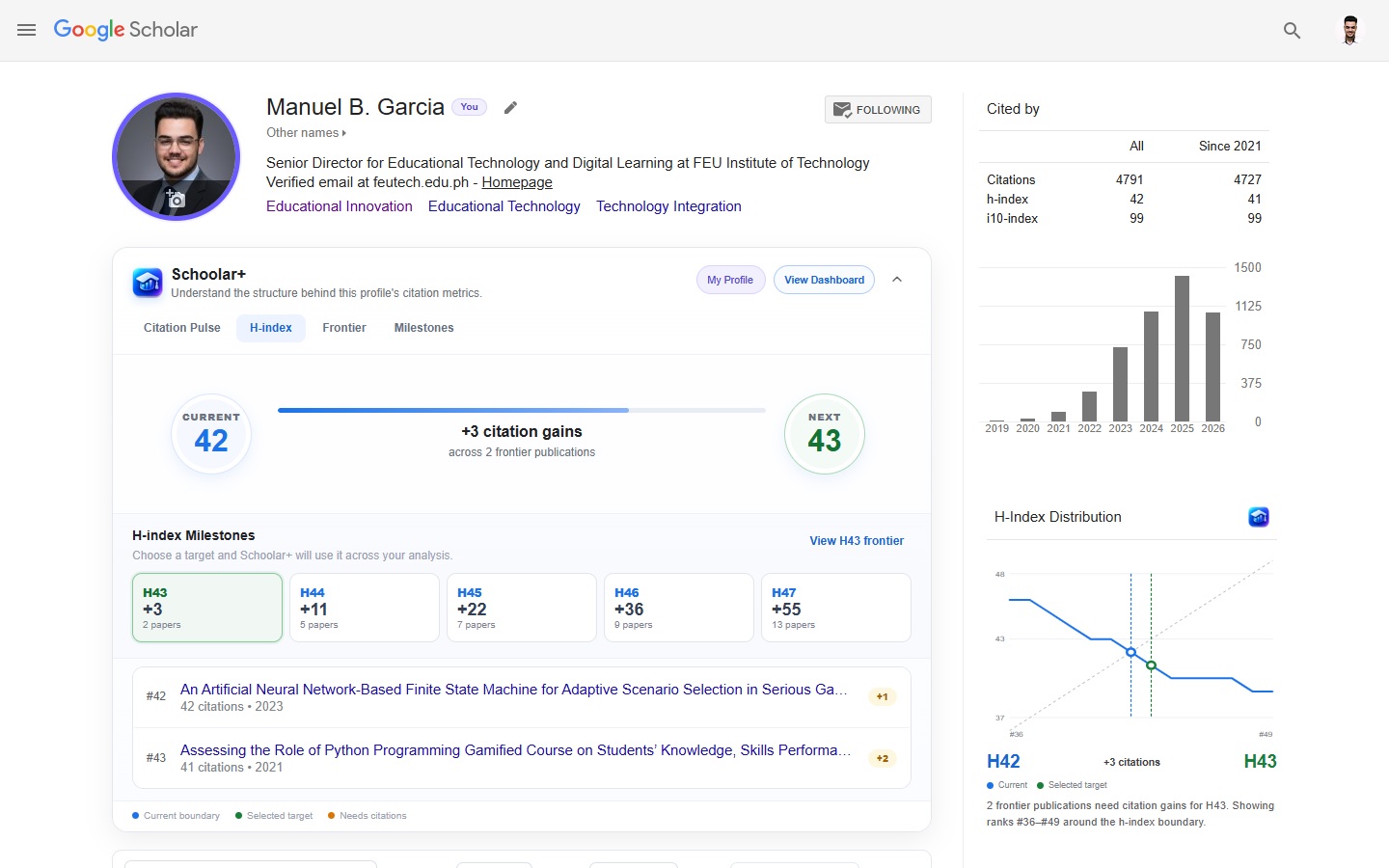
I can then make the more interesting decisions myself.
Is one of those papers part of a research program I should continue? Is there an unanswered question worth pursuing? Has an older study become timely again? Could the work be more discoverable? Is there a legitimate reason for a new project to build on it?
Sometimes the answer will be yes.
Sometimes the answer should be no.
That second answer matters just as much.
So, Can You Strategically Increase Your H-Index?
Yes, but I would be careful about what “strategically” means.
You can understand how the metric works. You can identify the publications around your citation frontier. You can make worthwhile research easier to discover. You can continue productive research programs rather than treating every publication as an isolated project. You can revisit work when new developments make it relevant. And when a new study genuinely builds on earlier work, you can connect the intellectual lineage properly.
What you cannot ethically guarantee is that anyone will cite you.
Nor should you try to engineer citations that have no scholarly reason to exist.
The best citation strategy is still remarkably unglamorous: produce useful research, make it discoverable, keep developing the ideas that deserve development, and give other researchers legitimate reasons to build on the work.
The h-index frontier simply helps you see where those efforts intersect with the mathematics of the metric.
And if you would rather not maintain the spreadsheet I maintained for years, well... that is now one less academic spreadsheet you need in your life.